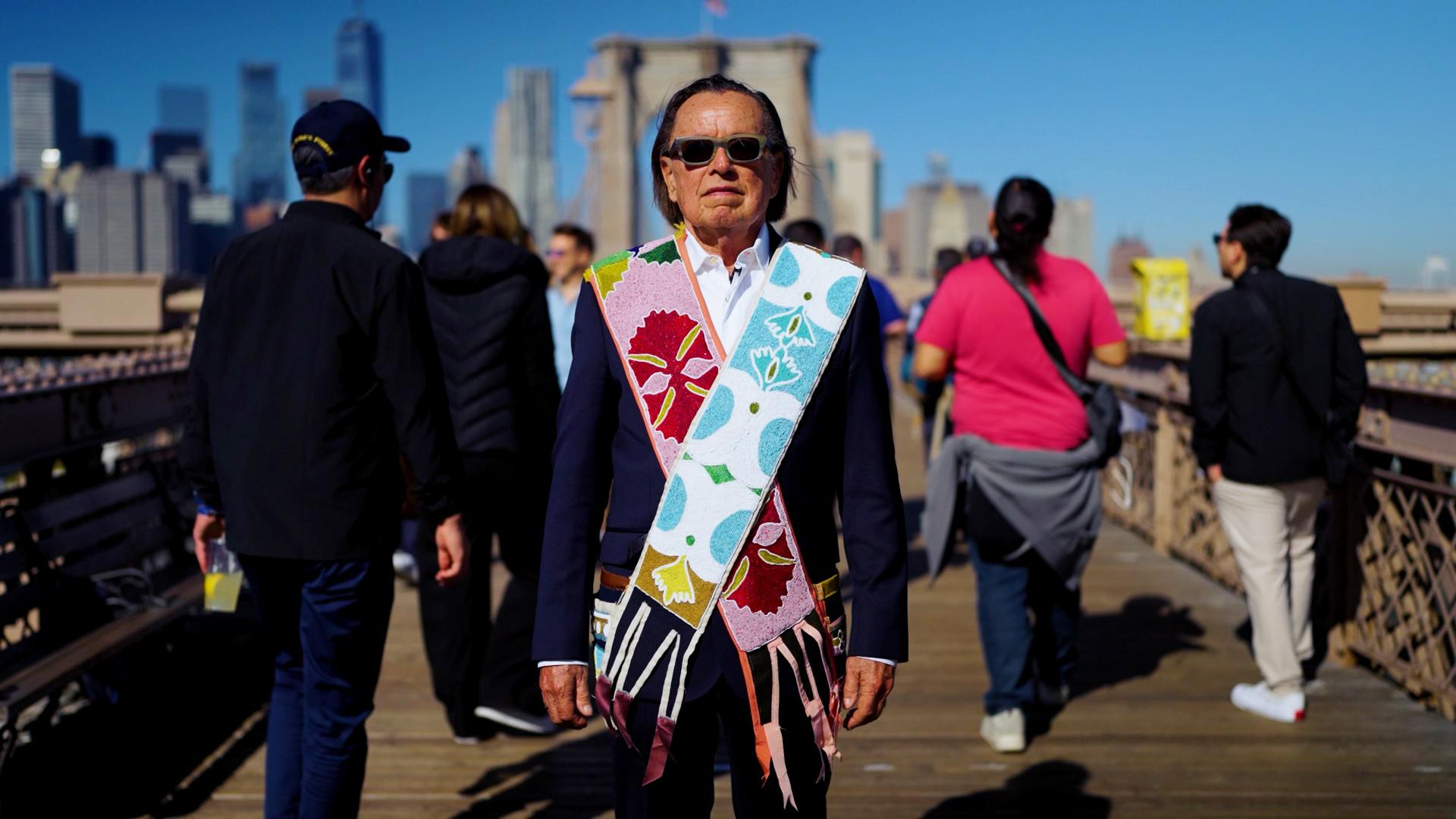
The Lenape Center, an organization that started in 2009, focuses on reclaiming space and preserving the history and culture of the Lenape people, who are indigenous to the land that we now know as New York City. As we commemorate the 400th anniversary of NYC, we acknowledge the Lenape tribes that lived here prior. We spoke with Joe Baker, co-founder of the Lenape Center, to learn about his personal journey and connection—or reconnection—to NYC, where he now resides. “Though we were displaced from our homeland, our ancestors remain here. Our culture continues to reverberate within the natural elements that of the territory, in the wind, the air, the water, the rocks. We exist eternally in our homeland,” he says. Read on to learn more about Baker, the Lenape Center and Indigenous representation in the founding of New York City.
Please share a bit about your journey and connection to New York City.
Joe Baker: I was born in Oklahoma. I’m a member of the Delaware tribe of Indians, one of the three federally recognized Lenape nations within the borders of the US. We all are diasporic communities that were forcibly removed from these territories, beginning first with the Dutch, followed by the British and then the US government.
My journey has been through arts and culture, as a curator, an artist, a museum director and cultural bearer. I was honored to be able to create the vision for Lenape Center 15 years ago with Hadrien Coumans. We’ve been at this work—pushing back on our erasure here in the homeland—through exhibits, symposiums and educational programming.
Tell me about your choice to move to NYC.
JB: Growing up in Oklahoma, I had the privilege to be around tribal elder Nora Thompson Dean, who was a speaker, medicine woman and cultural bearer within our community. She was an advocate for the return of our people through numerous visits starting in the 1970s and through the 1980s, up to the point of her death. She would return here to the homeland and present cultural programming. So as a kid growing up in Oklahoma, I knew this was our homeland, but Nora really is the one who planted that seed within me—that yearning to know more about this place. That really was the beginning of my journey of return.
What do you wish people understood about NYC when it was mainly occupied by Lenape people, before Dutch settlement?
JB: Lenapehoking, the territory of the Lenape people, is quite vast. It begins just south of the Catskills and runs along the Hudson River Valley, including the entire island of Manhattan, to all of the state of New Jersey and parts of the state of Delaware, and continues into Eastern Pennsylvania as far south as Philadelphia.
I want people to realize that Manhattan was a vibrant island populated by Lenape people. There were over 25 different village sites, all related through kinship, on the island. It was in many ways a paradise. Everything one needed to live and thrive was provided here—in the richness of the forest, and the rivers and sea. It wasn’t a desolate, deserted land. It was very populated and very desirable, first noticed by the Dutch as a place to be inhabited, conquered and colonized.
It’s also important for all people to begin to have a better understanding of the contribution that the Lenape people made to the formation and foundation of what we know as the United States of America. My fourth great-grandfather, Captain White Eyes, negotiated the Treaty of Fort Pitt—the first treaty with the US government—with General Washington. That alliance brought Lenape forces to join Washington’s effort to overcome the British and was key to the very beginnings of the US government: the Treaty of Fort Pitt in 1778 provided for an all-Lenape 14th state with representation in Congress.
Is there any significant Lenape population in NYC?
JB: We’re asked that question often, and we say five individuals. The number of Lenape people—tribal members living and working and existing here in the City—is quite small. We hope to change that through our work at Lenape Center because a big part of our mission is to create opportunities for tribal members to return home and avail themselves of the what the City offers through education and through the arts. We want to build a platform for people to come home.

Installation of "Welcome to Territory” by Lenape Center with Joe Baker in "Making Home—Smithsonian Design Triennial," Cooper Hewitt, Smithsonian Design Museum. Photo: Ann Sunwoo © Smithsonian Institution
Are there places where people can better understand Lenape culture and history in NYC?
JB: The Cooper Hewitt, Smithsonian Design Museum has an exhibition titled Making Home, which includes 25 installations by artists from the US, US territories and tribal nations. We at Lenape Center have the welcome exhibit at the entry of the show, and I would recommend everyone go there for a wonderful view of the diversity that makes up the United States today.
To feel that deep connection to Lenape history in Manhattan, I’d recommend Inwood Hill Park, at the northern tip of the island, which is sort of the last land that has been least interfered with in terms of development. You can go deep into the forest and be in the presence of gigantic tulip trees and the rock caves. It’s a beautiful area and much beloved by the people who live around the park. We recently partnered with the New York City Parks Department to start repopulating the wild plum along the waterways at Inwood. It’s a prime destination to gain a better understanding of what the island was like before colonization.

National Museum of the American Indian. Photo: David Sundberg
And of course there’s Bowling Green in Lower Manhattan. Across from it, the National Museum of the American Indian rests on the footprint of the original Fort Amsterdam. So there is a deep history there of collision.
What do you envision for the future of the Lenape Center?
JB: Our goal is to have a physical center here in Manhattan—a place where people can learn about Lenape history, our culture and our people, and a place for our community to come home to.
To learn more about the Baker's work, visit the Lenape Center website.